
Building management system for shopping malls and department stores using eS/FAC Serve.
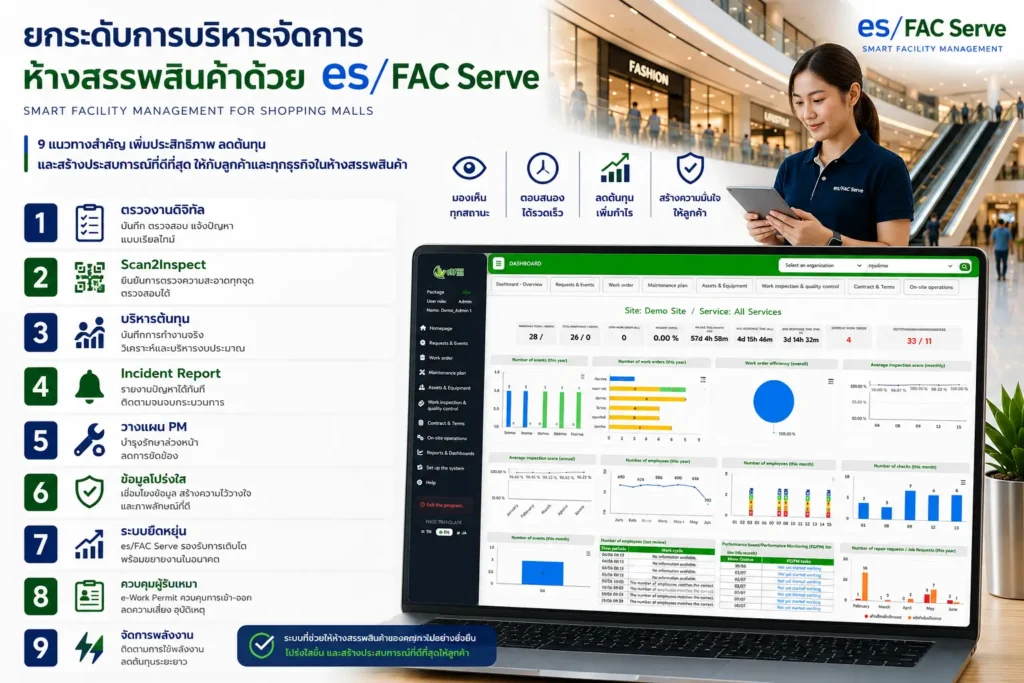
A shopping mall building management system is a system that helps building teams, engineering teams, and contractors in a shopping mall manage repair requests, preventive maintenance plans (PPM), and cleanliness and safety inspections in one place, along with verifiable evidence.
In the department store business, large spaces with high customer traffic at all times, a major challenge faced by management and operations teams is managing field teams, engineering teams, and contractors scattered throughout the area, whom supervisors cannot constantly oversee through facility management.
Coupled with fierce competition, department stores are pressured to quickly find ways to create a positive customer experience. This involves not only the aesthetics of the location but also safety, cleanliness, and the seamless availability of amenities to maintain brand image and sales.
Challenges and pain points faced by department store managers.
Executives and building managers in shopping malls often encounter recurring problems that undermine efficiency and increase business risk, such as:
– Paper-based inspections
Using paper checklists or group reports on LINE for cleaning and safety checks increases the risk of missing important checkpoints and delays in resolving on-site issues through the repair request system.
– Lack of a clear system for verifying operational performance.
It is impossible to verify whether the housekeeping or maintenance team is actually performing their duties on schedule or covering all areas, affecting the cleanliness and safety standards of the mall.
- Dealing with scattered and delayed problems.
When critical equipment malfunctions suddenly (such as elevators, escalators, or air conditioning systems), the information is not immediately reported to decision-makers, leading to delays in resolving the issue and impacting sales.
– Risks from external contractors (Vendors & Contractors)
Supervising repair, renovation, or installation work by external contractors during business hours is difficult and risky, and carries a high risk of accidents.
9 Guidelines for Upgrading Department Store and Shopping Mall Management with Digital Systems
To transition from traditional workflows to modern, transparent, and auditable practices, this article compiles nine key guidelines to help drive your department store towards greater efficiency.
1. Shift from paper-based work review to a real-time digital system.
The transition from paper checklists to a digital system using CMMS and CMMS software allows field teams to record results, verify tasks, and report problems instantly via mobile devices. This enables management and supervisors to see the real-time status of all areas in the mall through a central dashboard.
2. Create verifiable cleanliness at every point with Scan2Inspect.
Enhance safety standards and customer confidence by using work verification systems such as Scan2Inspect , which identifies and confirms that cleaning inspections of key areas occurred on-site, on time, and with verifiable evidence available at all times.
3. Manage costs more efficiently.
Implementing technology to record and monitor actual employee performance through a Maintenance Management System allows management to analyze data and efficiently manage human resource budgets relative to actual workload. An Asset Management System reduces waste and increases business profitability.
4. There is a system in place for quickly handling and reporting incidents (Incident Reporting).
When unexpected events occur, such as elevator or escalator malfunctions during daytime sales, a good digital system must be able to immediately record and report the incident, along with a system to track the status of the repair until the work order is issued , to prevent the problem from escalating and affecting sales.
5. Plan a systematic preventive maintenance program.
It helps the mall's engineering team plan for the maintenance of building systems in advance through a preventive maintenance plan , preventing malfunctions of critical equipment, reducing errors, and responding quickly to on-site problems.
6. Link data for transparency and to build confidence.
Allowing stakeholders transparent access to information and visibility into the system will build trust, enhance the shopping mall's professional image, and strengthen confidence among tenants under the standards of a building management system.
7. Control and monitor external contractors (e-Work Permit)
Manage the e-Work Permit system, control entry and exit, and monitor the work of contractors or vendors renovating and repairing areas within the mall, in order to reduce the risk of accidents and damage to the building structure.
8. Energy and Environmental Management System (Energy & Utility Monitoring)
Monitoring and analyzing energy usage within the shopping mall helps the engineering team plan energy saving strategies. Accurately checking for abnormalities in electrical and water systems through the maintenance program helps reduce long-term costs.
9. Choose a flexible and growth-oriented management system (eS/FAC Serve).
Choose a management system specifically designed for the building industry, such as eS/FAC Serve. Its flexible structure allows you to start with basic functions and immediately upgrade to support maintenance or multi-service as the mall expands or adds new services through facility management software, without the time and expense of a complete system upgrade.
It's time to upgrade your shopping mall's building management system.
Managing shopping malls in the digital age is not measured solely by space size, but also by speed, cleanliness standards, and safety in problem-solving. Implementing technologies like eS/FAC Serve can reduce paperwork, prevent business losses, and create a lasting positive customer experience.
Are you ready to upgrade the management of your department store and shopping mall?
👉 [Click here to schedule a consultation with an expert and watch a free system demonstration today!] Or contact us via Line Official and email to receive special offers tailored to your organization. Upgrade your management to Smart Operation today with eS/FAC Serve.